
Health & Nutrition Lounge
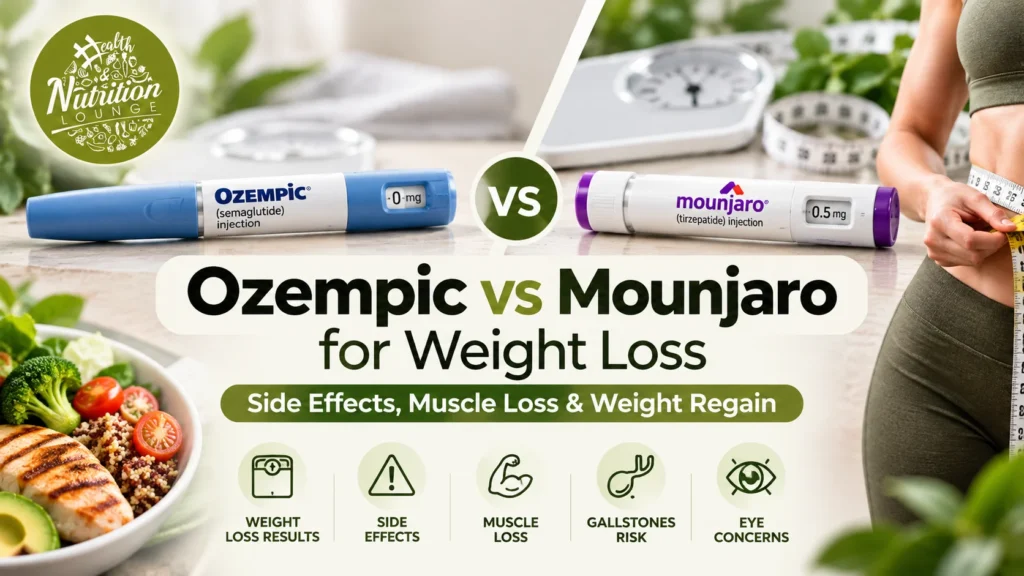
Ozempic vs Mounjaro for Weight Loss: Side Effects, Muscle Loss & Weight Regain
What is the difference between Ozempic and Mounjaro? Which one leads to more weight loss, what happens when you stop, and what should you know about muscle loss, gallstones and eye problems?
Ozempic and Mounjaro are now among the most talked-about medicines for weight management.
But are they really the same? How much weight can they help you lose? What happens when you stop? And what about muscle loss, gallstones and eye problems?
This guide explains Ozempic vs Mounjaro for weight loss in simple language, so you can understand what the evidence actually says before making decisions about your health.

Ozempic and Mounjaro are prescription medicines. They are not suitable for everyone and should not be started, stopped or changed without guidance from a qualified healthcare professional.
Ozempic vs Mounjaro: The Quick Answer
Both medicines belong to a newer group of medications that can significantly reduce appetite and food intake. However, they are not exactly the same.
Ozempic contains semaglutide and primarily works through the GLP-1 pathway.
Mounjaro contains tirzepatide and acts on both GIP and GLP-1 receptors.
In a 72-week clinical trial directly comparing tirzepatide with semaglutide in adults with obesity who did not have diabetes, tirzepatide produced greater average weight loss. This was a comparison of the medicines at the doses used in that obesity-treatment trial, so it should not be simplified to “Mounjaro is always better than Ozempic.”
Just as importantly, weight loss is only one part of the story. Long-term weight maintenance, nutrition quality, physical activity, muscle preservation and what happens after stopping treatment also matter.
Ozempic vs Mounjaro for Weight Loss: Comparison
| Feature | Ozempic | Mounjaro |
|---|---|---|
| Active ingredient | Semaglutide | Tirzepatide |
| Main mechanism | GLP-1 receptor agonist | GIP + GLP-1 receptor agonist |
| Effect on appetite | Reduces appetite and food intake | Reduces appetite and food intake |
| Weight-loss evidence | Strong evidence | Strong evidence, including direct comparison with semaglutide |
| Common digestive effects | Nausea, vomiting, diarrhea, constipation | Nausea, vomiting, diarrhea, constipation |
| Long-term consideration | Weight regain may occur after stopping | Weight regain may occur after stopping |
What Are Ozempic and Mounjaro?
What is Ozempic?
Ozempic contains semaglutide. It is a GLP-1 receptor agonist that helps regulate blood glucose and can reduce appetite and food intake.
Ozempic is primarily known as a medicine for type 2 diabetes. Semaglutide is also available in different products and doses specifically approved for chronic weight management.
What is Mounjaro?
Mounjaro contains tirzepatide. Unlike semaglutide, tirzepatide activates both GIP and GLP-1 receptors.
This dual action can have a powerful effect on appetite, food intake, blood glucose regulation and body weight.
Tirzepatide is also available under another brand name for chronic weight management in some markets. Product names, indications and availability can vary by country.

How Do GLP-1 Weight Loss Injections Work?
Your body naturally produces hormones that help control hunger, fullness and blood sugar.
Medicines such as semaglutide and tirzepatide mimic or activate some of these pathways. As a result, many people experience:
- Less hunger
- Earlier fullness during meals
- Reduced food intake
- Slower stomach emptying with GLP-1 activity
- Improved blood glucose regulation
This is one reason these medicines can make weight loss easier for some people. But the medicine does not replace the need for adequate nutrition, resistance exercise, sleep and long-term behavior changes.
Which Is More Effective for Weight Loss?
One of the most important studies for this question is the SURMOUNT-5 trial, published in the New England Journal of Medicine in 2025.
Researchers directly compared tirzepatide with semaglutide in adults with obesity who did not have diabetes. Over 72 weeks, participants receiving tirzepatide experienced greater average weight loss than those receiving semaglutide.
That finding is important, but there is a common misunderstanding online: the study does not mean that every person taking tirzepatide will lose more weight than every person taking semaglutide.
Individual results depend on dose, treatment duration, starting weight, medical conditions, food intake, activity level, adherence and many other factors.
Read the SURMOUNT-5 trial

Ozempic Side Effects vs Mounjaro Side Effects
The most common side effects with both medicines involve the digestive system.
Common side effects can include:
- Nausea
- Vomiting
- Diarrhea
- Constipation
- Abdominal discomfort
- Reduced appetite
These effects are often more noticeable when treatment is started or the dose is increased. Some people tolerate the medicines very well, while others may have significant symptoms.
Severe or persistent symptoms should not simply be ignored. Anyone taking these medicines should follow the prescribing clinician’s instructions and report concerning symptoms.
Ozempic, Mounjaro and Gallstones: Is There a Connection?
Gallbladder problems, including gallstones, have been reported with GLP-1-based medicines.
But there is an important point that is often missed on social media: rapid or substantial weight loss itself can increase the risk of gallstones.
So it is not accurate to simply say, “Ozempic causes gallstones” or “Mounjaro causes gallstones.” The risk can be influenced by the medicine, the amount and speed of weight loss, and the person’s individual health history.
Ozempic and Mounjaro Muscle Loss: Should You Be Concerned?
This is one of the most important parts of the conversation about weight-loss injections.
When a person loses a significant amount of weight, the body does not lose only fat. Some lean tissue can also be lost.
That does not mean these medicines simply “destroy muscle.” It means that rapid or substantial weight loss needs to be managed carefully so that unnecessary loss of lean tissue is minimized.
Body-composition research with tirzepatide has found that a large proportion of the weight lost came from fat mass, while a smaller proportion came from lean mass. However, lean mass is not identical to skeletal muscle, and individual results vary.

This is why the goal should not be only:
A better goal is:
How to Protect Muscle During Weight Loss
Whether you are losing weight naturally or using a GLP-1 weight loss injection, your nutrition strategy matters.
- Eat enough protein: Spread protein-rich foods across your meals instead of trying to eat most of your protein at one time.
- Do resistance training: Strength training gives your body a reason to preserve muscle while you lose weight.
- Avoid extreme calorie restriction: Eating as little as possible is not the goal.
- Stay physically active: Walking and daily movement remain useful even when appetite is lower.
- Prioritize nutrient-dense foods: Smaller meals still need to provide protein, vegetables, whole grains or other quality carbohydrates, healthy fats and essential micronutrients.

If you want a structured approach to sustainable weight management, you can explore our Weight Transformation Program
Ozempic and Eye Problems: What Should You Know?
Eye-related concerns are another topic that often becomes exaggerated online.
People with diabetes can already have diabetic retinopathy, and rapid improvements in blood glucose can sometimes temporarily affect diabetic retinopathy. This is why people with diabetes and existing eye disease should discuss treatment with their healthcare provider.
It would be misleading to tell everyone that Ozempic or Mounjaro simply “causes blindness.” Eye risks depend on the individual’s medical history and the specific clinical situation.
If you have diabetes, existing diabetic retinopathy or new changes in vision, make sure your prescribing doctor and eye specialist know about your treatment.

What Happens After Stopping Ozempic?
This is one of the most important questions people should ask before starting treatment.
In the STEP 1 extension study, people who stopped semaglutide after the main treatment period regained a substantial amount of the weight they had previously lost during the following year.
In simple terms, the medicine had helped reduce appetite and support weight loss. Once the medicine was withdrawn, some of those effects were no longer present.
This does not mean that everyone will regain all their weight. It means that weight maintenance after stopping treatment can be difficult and should be considered from the beginning.
Read the STEP 1 extension study on PubMed
What Happens After Stopping Mounjaro?
Tirzepatide shows a similar long-term issue.
In the SURMOUNT-4 trial, people who continued tirzepatide maintained and extended their weight reduction, while people switched from tirzepatide to placebo experienced substantial weight regain.
This is why it is useful to think about these medicines as part of a long-term obesity treatment strategy, rather than as a short “injection course” followed by a return to the old routine.
Read the SURMOUNT-4 trial on PubMed
More recent research has also examined weight regain after stopping tirzepatide, further highlighting the importance of long-term weight-management planning.
View the 2026 tirzepatide withdrawal analysis on PubMed
Can You Lose 10% of Your Weight Without Injections?
For some people, yes.
But it is important not to turn this into a promise that everyone can “easily” lose 10% of their body weight simply by changing their routine.
Some people achieve clinically meaningful weight loss through structured nutrition, physical activity, sleep improvement and behavior change. Others have obesity, insulin resistance, metabolic disease, medication-related weight gain or other factors that make weight loss considerably harder.
The right approach depends on the person.
If you want to understand the fundamentals of sustainable fat loss, read:
Want to Lose Weight? Here’s What Actually Works Without Starving Yourself
.
More HNL Resources on Sustainable Weight Loss
Ozempic and Mounjaro in Pakistan: What Patients Should Consider
Interest in Ozempic Pakistan, Mounjaro Pakistan and other weight loss injections has increased considerably.
But buying or using an injectable medicine simply because it worked for a friend, influencer or someone on social media is not a safe approach.
Before starting treatment, a healthcare professional should consider your:
- Current weight and waist circumference
- Medical history
- Blood glucose and metabolic health
- Current medications
- Digestive and gallbladder history
- Eating pattern and nutritional status
- Physical activity and strength level
- Previous weight-loss attempts
Product availability, prescribing requirements and approved indications can also differ between countries. Use medicines from legitimate, regulated sources and avoid unverified online products.
Why Nutrition Still Matters When You’re Taking a Weight-Loss Injection
One of the biggest misconceptions about GLP-1 weight loss injections is that once you start the medicine, you no longer need to think about nutrition.
In reality, nutrition becomes even more important when appetite is reduced.
If you are eating much smaller portions, every meal has to work harder to provide the nutrients your body needs.
A good nutrition strategy should help you:
- Meet protein requirements
- Maintain muscle and strength
- Get enough vitamins and minerals
- Manage digestive symptoms
- Develop sustainable eating habits
- Prepare for long-term weight maintenance
Explore our Health & Nutrition Services if you are looking for professional nutrition support.
Questions to Ask Before Starting Ozempic or Mounjaro
- Is this medicine appropriate for my health condition?
- What dose should I start with?
- What side effects should I watch for?
- Do I have any risk factors for gallbladder problems?
- Do I need eye monitoring?
- How will we protect my muscle mass?
- What should I eat while taking the medicine?
- How much protein do I need?
- Should I start resistance training?
- What is the long-term plan if I eventually stop treatment?
Don’t Let the Scale Be Your Only Goal
Weight loss is not only about seeing a smaller number on the scale. Your nutrition, muscle mass, strength, metabolic health and ability to maintain your progress matter too.
Whether you are considering a weight-loss injection or trying to lose weight without medication, a personalized nutrition strategy can help you make better decisions.
Frequently Asked Questions
The Bottom Line
Ozempic vs Mounjaro for weight loss is not simply a question of which injection produces the biggest number on the scale.
Tirzepatide has produced greater average weight loss than semaglutide in a direct 72-week trial in adults with obesity without diabetes. At the same time, both treatments have potential side effects, and weight regain can occur after treatment is stopped.
The bigger question is how to lose excess body fat while maintaining good nutrition, strength, muscle and long-term habits.
A medication can be one part of the treatment. Your long-term nutrition and lifestyle strategy still matter.
Scientific References
- Jastreboff AM, et al. Tirzepatide as Compared with Semaglutide for the Treatment of Obesity. New England Journal of Medicine.
- Wilding JPH, et al. Weight regain and cardiometabolic effects after withdrawal of semaglutide. Diabetes, Obesity and Metabolism.
- Aronne LJ, et al. Continued Treatment With Tirzepatide for Maintenance of Weight Reduction in Adults With Obesity. JAMA.
- Recent analysis of weight regain following tirzepatide withdrawal. PubMed.
This article is for educational purposes only and should not be considered a substitute for medical diagnosis, treatment or individualized medical advice. Ozempic, Mounjaro and other prescription medicines should only be used under the supervision of an appropriately qualified healthcare professional.
Explore Health & Nutrition Lounge:
Health & Nutrition Services
Weight Transformation Program
Our Locations